Skip to content
zensation

Research overview

Three tracks, architecture and agenda

Publications

Preprints, software, identifiers

Methodology

Operational standards and validation

Research ethics

Fundamental rights and compliance

Resources

Code, data, citation, open science

Adopt AI

Neutral roadmap & interactive simulation

Public sector & funding

Collaborations in the public sector

Protecting public spaces

Track B — rights-preserving early warning

Applied AI · knowledge work

Track C — memory for knowledge work

Technology

The architecture behind every application

Playground

Run the open memory core live

Work with usAboutOpen SourceBlog
EN·DE
Contact
zensation
Research overviewPublicationsMethodologyResearch ethicsResources
Adopt AIPublic sector & fundingProtecting public spacesApplied AI · knowledge workTechnologyPlayground
Work with usAboutOpen SourceBlogContact
Blog
Engineering

Ten judges, 1.48 votes: what an LLM judge panel is really worth

Alexander Bering
Alexander Bering
October 30, 2026 · 3 min read

Many evaluations let several language models judge the same answer and take the majority, and the level of agreement is often read as confidence. Both steps assume the voters are independent. voteworth is a small open package that checks that assumption.

What it measures. For every pair of voters, voteworth counts how often both deviate from the panel's majority with the same answer. Three quantities follow: the effective number of independent voters after Kish, a weight per voter (1 divided by 1 plus the sum of its shared errors) and a corrected vote. The weighting needs no gold labels; the computation is closed-form and needs only numpy.

What the bundled data show. Ten real model voters from four model families over eighty items, reproducible without network or API key: - The panel is worth 1.48 independent votes. - When two voters of the same model were wrong, they were wrong the same way 42.8 percent of the time; across different models, 18.5 percent. - On the held-out half (29 items), the weighted vote raised accuracy from 44.8 to 51.7 percent and reduced overconfidence. The best single voter stayed ahead at 58.6 percent; here, voting was the wrong move, and voteworth shows exactly that.
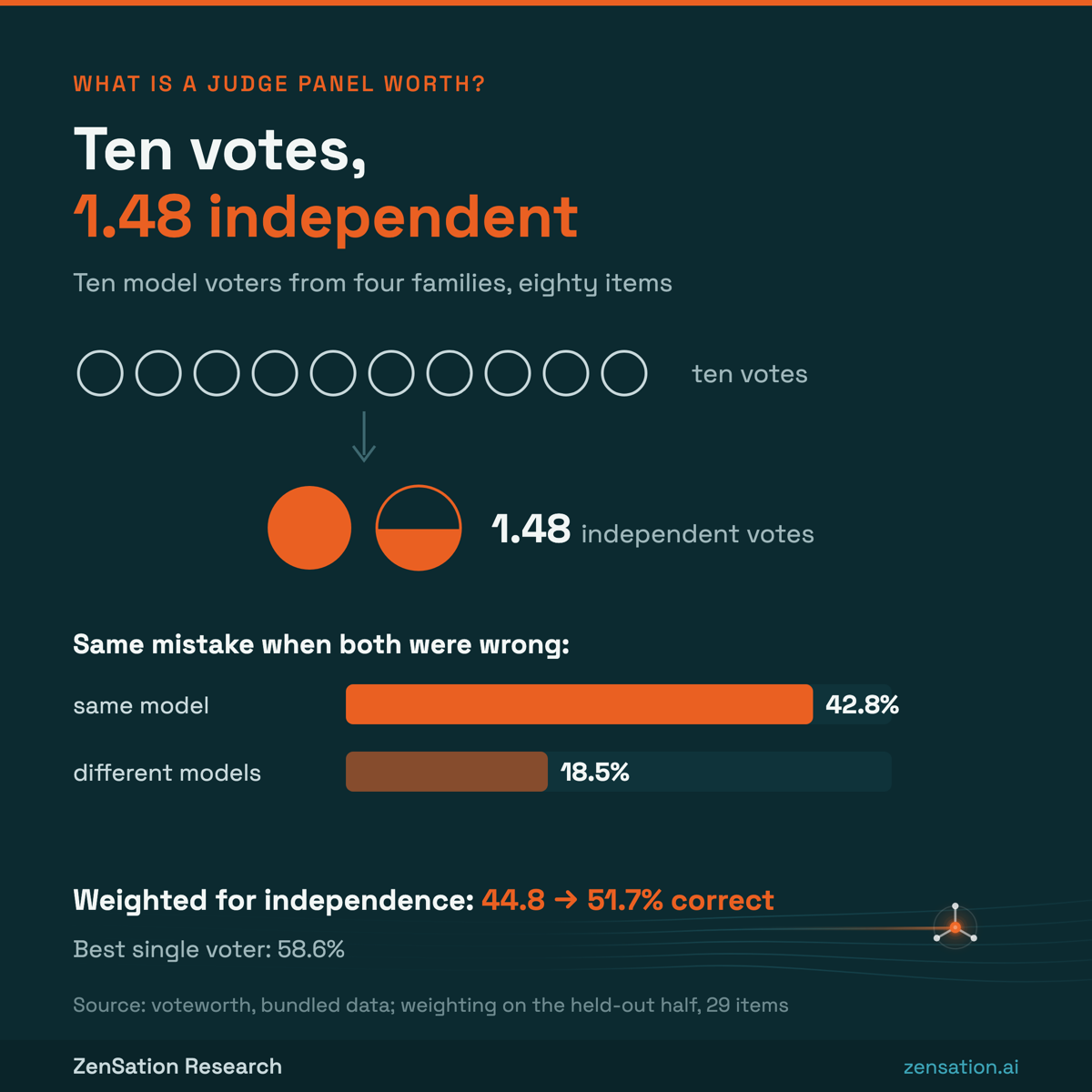
Graphic in petrol design. Title: Ten votes, 1.48 independent. Ten circles stand for ten model voters from four model families on eighty items; below, one full and one almost half-filled orange circle for 1.48 independent votes by Kish's effective sample size. Two bars show the same mistake when both voters were wrong: 42.8 percent for the same model, 18.5 percent for different models. Bottom: weighted for independence, accuracy on the held-out half of 29 items rose from 44.8 to 51.7 percent; the best single voter stood at 58.6 percent. Source: voteworth, bundled data.

Chart: voteworth 0.1.0, bundled data. Weighting and accuracy on the held-out half (29 items).

The limit, stated plainly. A panel made of one model cannot be improved by reweighting; the demo then prints "INERT". And when a correlated bloc holds the majority, it never deviates and so never looks correlated; the effective vote count still falls, which is how the case shows. A test in the package pins this limit.

Context. Verga et al. (2024) recommend panels drawn from different model families; the measurement here shows why diversity is needed and that it is not enough on its own. voteworth is a screen for your own panel, not a benchmark and not a model ranking.

Try it: pip install git+https://github.com/zensation-ai/voteworth && python -m voteworth.demo. The numbers above come from voteworth 0.1.0 at commit 12572d5 and come out the same on every run of the demo.

Share on XShare on LinkedIn

Related Articles

The Stress Test: Why We Ran Ten Security Sprints Before the First Customer

Between 'it runs on my machine' and 'a company entrusts it with its data' lies a gap. How we bridged it with ten hardening sprints.

From AI Overview to a Real Demo: Turning a Blueprint into a ZenAI Instance — Autonomously

Here's how a quick assessment turns autonomously into a lightweight, sector-accurate ZenAI instance — and why honesty is the most important building block.

An Architecture for Memory: The First Sketches

Mid-2024: the question of what it would mean to give an AI system a real long-term memory took the form of an architecture sketch. ZenBrain begins here.

zensationIndependent AI research lab · Kiel
ResearchPublicationsMethodologyResearch ethicsResourcesMemory architecturesBenchmarksAgent memory comparedAdopt AIPublic sectorProtecting public spacesApplied AITechnologySystem explorerPlaygroundEigenraumWork with usOpen SourceAboutBlogChangelog
GitHubLinkedInarXivZenodoORCIDScholarSemantic ScholarHuggingFacenpmDiscussions

© 2026 Alexander Bering / ZenSation Enterprise Solutions

RSSPrivacy PolicyLegal NoticeAccessibility