
Coding agents forget between sessions what they learned about a project. ZenBrain gives Claude Code a memory that lasts, installed as a plugin with one line.
Install (from the terminal with Claude Code 2.1.292 or newer, Node.js 22 or newer): claude plugin install zenbrain --marketplace zensation-ai/zenbrain Inside a running session the same works from 2.1.275 as /plugin install zenbrain --marketplace zensation-ai/zenbrain.
The five tools. zenbrain_store saves something and picks the layer from the content. zenbrain_recall searches episodes, facts, procedures and core memory and ranks hits on one scale from 0 to 1. zenbrain_forget deletes on purpose, together with what consolidation made of it. zenbrain_consolidate turns selected episodes into facts without deleting anything from long-term memory. zenbrain_health shows how full each layer is.
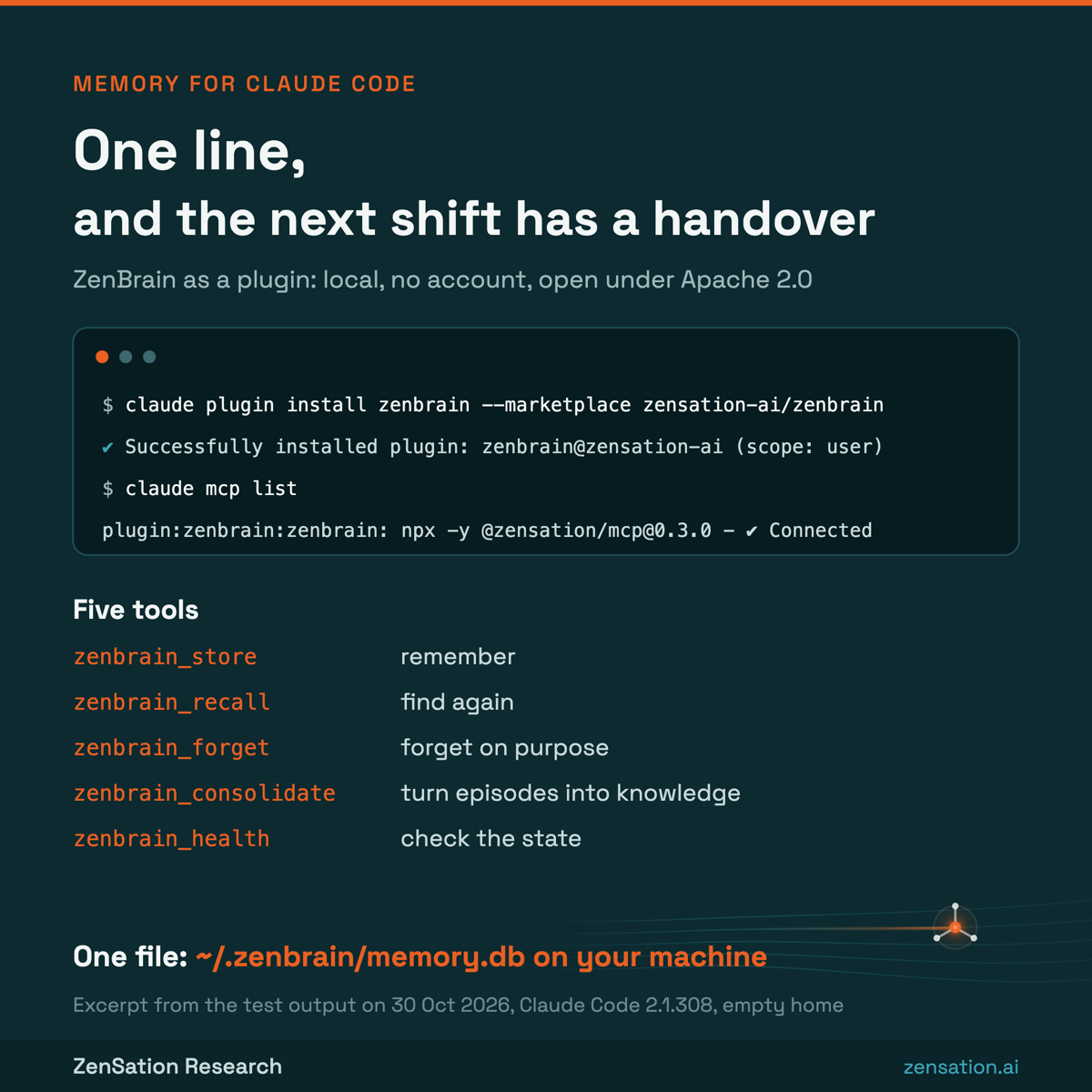
Chart: excerpt from the test output on 30 October 2026, Claude Code 2.1.308, empty home directory.
Where the memory lives. In ~/.zenbrain/memory.db, an SQLite file on your machine. Choose another place at install time: --config db_path=~/notes/zenbrain.db. Uninstalling leaves the file in place.
What the plugin downloads. It starts the server @zensation/mcp at a fixed version (currently 0.3.0) through npx. On first start npx fetches that version from the npm registry; after that the server makes no network call of its own. It calls no language model.
Why layers. Memory research distinguishes episodes, knowledge and skills. ZenBrain keeps them apart, and when episodes become knowledge the episode stays. A recall finds the general fact and the single case it came from. Why that matters is the subject of the memory tax.
More: the plugin on GitHub · the MCP server for Claude Desktop and Cursor.