
Picture a mid-sized company that seems to be doing everything right. It buys AI licences for half the workforce. It starts a pilot with the IT team. The board presentation is proud, the mood is good, the slides are full of promise. Six months later the managing director asks the room: so what has it brought us? Silence. We are still in the pilot phase.
This scene is repeating itself thousands of times right now, in almost every industry. And it almost never has the cause everyone assumes.
The numbers are unambiguous by now. In 2025 the Boston Consulting Group studied around 1,250 companies. Only five percent capture value at scale. Sixty percent capture no material value at all. McKinsey reached the same picture the same year across nearly 2,000 firms. More than eighty percent feel no effect on the bottom line. McKinsey calls it, soberly, the "gen AI paradox": almost everyone uses AI, almost no one earns from it.
You may have read the more dramatic headline, that ninety-five percent of AI pilots fail. It comes from an MIT report. I deliberately do not use it as proof here. It is preliminary, not peer reviewed, and the sender happens to sell the matching solution. The clean anchor is the BCG study. It says the same thing at heart, only soundly: the value does not arrive.
That leaves the real question. Not whether. Why. And the answer shifts the whole field.
We talk about the model. It is almost never the model.
The convenient explanation would be that the technology is not ready yet. It is wrong. The models have become powerful and cheap, and for almost every use case a suitable one is available. Whoever fails today does not fail on compute.
McKinsey weighed more than twenty-five possible success factors against each other. The strongest lever on the result, by far, is not the model. It is the redesign of workflows, end to end. BCG turns the same principle into a rule of thumb worth framing. It is called 10-20-70. Ten percent of the effect comes from the algorithms. Twenty from the technology. Seventy from people and processes.
Read that split twice. It means the thing everyone talks about, which model, which vendor, which feature, is the smallest part. The thing almost no one talks about, how work is organised and how people are brought along, is the largest.
There is an old line from the data world that nails it. "Garbage in, garbage out." Put a brilliant model on a poorly understood process and on unkept data, and you get expensive standstill. AI does not make the bottleneck underneath disappear. It only makes it visible, and costly.
A coal mine in Durham, and why better technology can be worse
That you can introduce a new technology and optimise the wrong thing is not an insight of the AI age. It is more than seventy years old, and it comes from a coal mine.
In the late 1940s British collieries mechanised extraction. Before that, small groups of miners had worked largely on their own. They could do several jobs, supported each other, organised themselves. The new machine method broke that apart. The small, versatile teams became large crews split into rigid single-task shifts. Each man did just one motion. The technology was more modern. The result was worse: less output, more absenteeism, more conflict.
A researcher at London's Tavistock Institute, Eric Trist, described in 1951 what had happened. The technical system had been optimised and the social one destroyed in the process. Only when the work was recut so that machine and self-organising teams fit together again did productivity and satisfaction rise. Trist called the principle the joint optimisation of people and technology. It became the birth of socio-technical thinking.
The parallel to today is almost uncanny. Once again the new capability of machines outpaces the speed at which organisations rethink their work. The machine is rarely the problem. The unsolved surroundings are.
Not a failure, but a familiar pattern
It gets even more reassuring. That value is missing at first is not only explainable, it is predictable.
The economists Erik Brynjolfsson, Daniel Rock and Chad Syverson have a model for it, the productivity J-curve. The idea is simple. A fundamental technology demands large accompanying investments: new processes, new organisation, new skills. These investments are invisible. They sit on no balance sheet. So you first see only the cost and no return yet. Measured productivity falls before it rises. That makes the shape of a J.
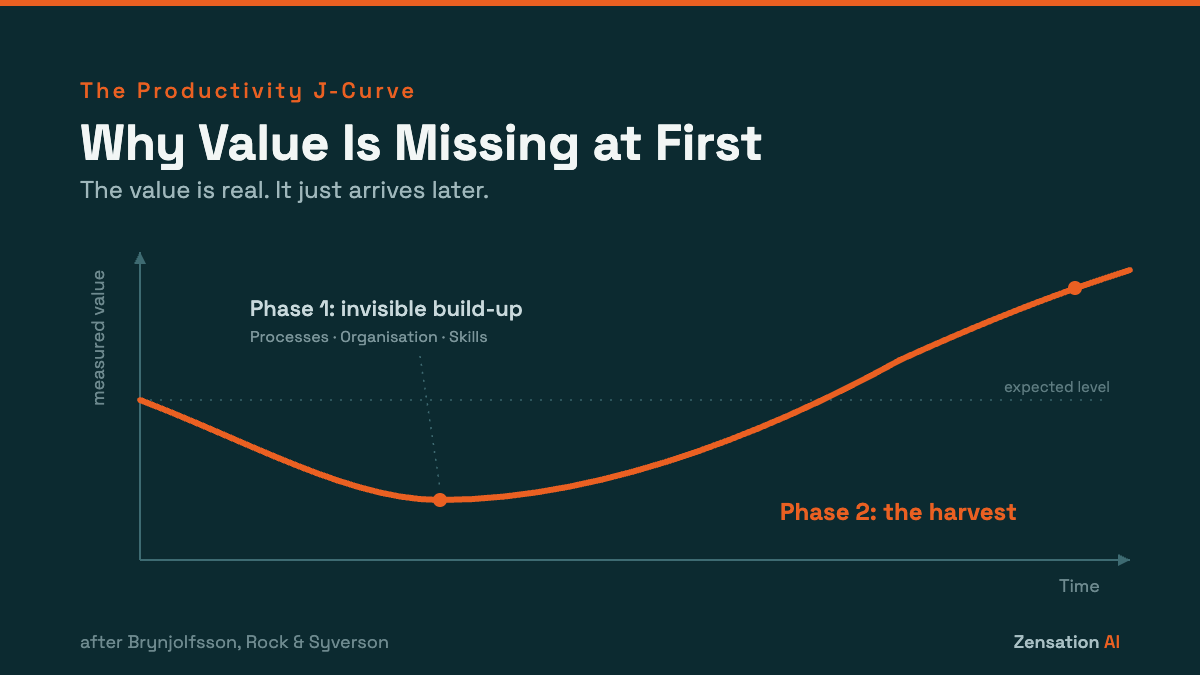
Picture an orchard. You clear, plant, water, prune. For years the books show only expense. The harvest comes later, and then abundantly. Brynjolfsson and colleagues put a number on it. Account for the invisible investments, and the true productivity of the US economy at the end of 2017 was almost sixteen percent above what was officially measured. The value was there. It was just still in the soil, not in the fruit.
Whether AI follows the same timetable is open in 2026, and I do not claim it. But the principle stands beyond doubt. The value of a base technology does not arise in the tool. It arises in the work you reorganise around it. The value gap is therefore no proof against AI. It is the expectable early state, as long as that work is not done.
Maturity beats size
Does this hold for the German Mittelstand too, which rarely has corporate budgets? Here the data is surprisingly clear, and it comes from sources no one suspects of starry-eyed enthusiasm.
In early 2026 the KfW evaluated its representative Mittelstand panel. Twenty percent of mid-sized firms now use AI, a fivefold increase in a few years. Among larger firms it is thirty-six percent, according to Bitkom. But usage stays on the surface. On average it is two applications per company, and barely a quarter even has rules for it. A lot of beginning, little depth.
The pattern does not end at the German border. In Switzerland, according to the 2025 AXA SME study, thirty-four percent of small and mid-sized firms now use AI actively, a rise of more than half within a year. In Austria the chamber of commerce reports forty-four percent for the knowledge-intensive sectors. The figures vary with the definition; the picture behind them is everywhere the same: fast spread, little depth.
The most important finding sits in the fine print of the KfW analysis. In the raw numbers, large firms use more AI than small ones. But once you factor out the company's knowledge base, that is graduates, research, a digital strategy, the size effect disappears entirely. Statistically meaningless. It is not size that decides, but maturity.
Behind this sits a well-documented principle from organisational research. As early as 1990 the economists Wesley Cohen and Daniel Levinthal showed that a company can absorb the new only to the degree that it already holds related knowledge. They called it absorptive capacity. No connecting points, no docking. An organisation without digital maturity cannot simply buy AI. It first has to build the places where the new can take hold. That is why the same software ignites in one company and fizzles in the next.
From this the KfW draws a conclusion I would almost sign word for word. AI must "not be used only in isolated spots, but integrated broadly and intensively into processes, products and business models," complemented by investment "above all in the qualification of employees." The ifo Institute says the same in other words the same year. Whether AI ends up helping or harming depends "decisively on operational implementation." When the development bank and the leading economic institute independently reach the same result, you should listen. The success factor is implementation.
People are not the obstacle you take them for
That brings us to the most sensitive part, the human one. And here you first have to dispose of two popular stories.
The first goes: seventy percent of all change initiatives fail. That number is a myth. The researcher Mark Hughes examined the five usual sources for it in 2011 and found no evidence in any of them. Only a chain of citations copying from one another. Whoever criticises the AI hype should not use invented numbers themselves. I leave it out.
The second story goes: people do not want AI. That is not true either. In the experiments of researcher Jennifer Logg, people trust the very same advice more when they believe it comes from an algorithm. At the same time a German study shows that when a risky decision with real responsibility is at stake, only twenty-three percent hand the choice to the machine. Both are true. It depends on context, not on some alleged hostility to technology.
What really matters is more concrete and more controllable than the fear headlines suggest. It is three things: trust, control and experience.
Trust has to be dosed correctly, not maximised. Too little, and a good system goes unused. Too much, and no one notices when it is wrong. In the German population, seventy-seven percent of non-users name lack of trust as the main reason.
Control is perhaps the strongest lever of all, and one experiment makes it beautifully clear. Researchers around Berkeley Dietvorst at the University of Chicago showed subjects an algorithm that was demonstrably better than they were, but not perfect. When they were not allowed to touch the result, only thirty-two percent wanted to use it. When they could adjust it just a little, it was seventy-three. Same technology, same accuracy. The only difference was a steering wheel. The human in the decision loop is therefore not a moral gesture. It is the condition for the system being used at all.
And experience beats every argument. Among those who use AI, seventy percent say it makes life easier. Among non-users, fear and the feeling of being left behind dominate. The difference is often just the first time you touch it yourself.
This is no longer just good practice, it is law. Since February 2025, Article 4 of the EU AI Act has required every company that uses AI to ensure a "sufficient level of AI literacy" among its staff. From August 2026 supervisory enforcement is added. Bitkom shows the gap. Forty-three percent of firms offer no training at all, seventy percent of employees get no offer. Rarely do the strongest lever and the law point so clearly in the same direction.
What collective intelligence really means
We like to talk about "people and machines together." It sounds like progress. But does it work?
The most honest answer comes, of all places, from the research group that coined the term collective intelligence, the team around Thomas Malone at MIT. In 2024 it summarised one hundred and six studies in the journal Nature Human Behaviour. The result is uncomfortable. On average, human-AI combinations perform worse than the better of the two alone. Simply placing a human next to the AI does not, on average, make it better. It often makes it worse.
Synergy arises only under conditions, and they can be named. It arises in creative tasks, less in pure decisions. And above all when the human is the stronger partner. If the human alone is better than the AI, the team beats both. If the AI is better, the human drags the result down. In plain terms: collective intelligence is no automatism that appears because you wire two things together. It is a design task. You have to decide which task goes to whom, who leads, and where the human intervenes.
This fits everything we know about good teams. The studies of Anita Woolley show that groups have something like their own intelligence score. And it depends less on the IQ of the heads than on the how of the collaboration. Who lets others finish. Who is socially perceptive. Whether speaking time is shared or one person dominates. In the large follow-up analysis this how is about twice as important as the abilities of the individuals. In fairness: the finding is debated in the research, I do not sell it as a law of nature. But the direction is robust, and it matches the mine in Durham. Optimise the technology alone and you make it worse. Optimise people and technology together and it holds.
Collective intelligence is therefore not a marketing word. It is the precise description of what this is about. The designed interplay of human and machine on a shared structure. In technical language that structure has a name, the cognitive architecture. The model is interchangeable. It is not.
Starting without mortgaging the future
If the value of AI arises in implementation, then everything is decided at the start. And that is exactly where the most common mistake is made. People build fast pilots that lead nowhere. Research calls this state pilot purgatory. A large share of projects never gets past the first test, not because the technology fails, but because no one thought about the day after. The numbers are stark. Gartner expects at least one in three projects to be shelved after the first test. A survey by S&P Global found that in 2025 companies scrapped, on average, forty-six percent of their prototypes before they reached production.
The way out is not a bigger model, but a smarter first cut. Three principles hold.
First, few deep use cases instead of many shallow ones. Better one process you genuinely rethink than ten tools running side by side, unconnected.
Second, measure before you build. Define the metric before the pilot, not after. Astonishingly few organisations do this. And they are exactly the ones who later cannot show any value.
Third, build modular, not as a throwaway prototype. As early as 2015 Google researchers described the "hidden technical debt" in machine learning systems. Their core line, in spirit: in such systems, changing anything changes everything. Whoever builds the first pilot as an isolated island pays for it with every extension. Whoever lays it down as a reusable building block builds a foundation. This holds above all for the layer in which the company's knowledge lives. If the system learns from daily work and keeps what it has learned, the second use case becomes cheaper than the first. If it does not, you explain the same thing to the AI anew every Monday.
In seven sentences, to take with you:
- Leadership anchors a value ambition and carries it visibly. AI is not delegated downward.
- Think 10-20-70. The focus is on people and processes.
- Few deep use cases, each with a metric fixed before the start.
- Clarify data maturity and knowledge sovereignty first. Available is not the same as sovereign.
- Design the human-machine team deliberately. Give people control and a first experience of their own.
- Build competence. It is law and at the same time the strongest lever.
- Build modular. The first pilot should make the second easier, not harder.
Who owns the layer that learns?
In the end it all comes down to one question that is missing from most strategy papers. Not "which model." But: who owns the layer in which the company's knowledge lives?
Because that is where the value that stays is created. You can swap a model like a supplier. The process knowledge of an organisation, grown over years, you cannot. If that layer sits in a foreign cloud, the responsibility is in the house but the sovereignty is elsewhere. Being compliant is not the same as owning it. The one protects against fines. The other protects the value.
The shift we are living through is therefore not from the smaller to the bigger model. It goes from artificial to collective intelligence. From the question of what the tool can do, to the question of how human and machine work together on a structure the company truly owns.
The good news sits in the same insight as the bad. When AI fails, it is rarely because of the AI. Which means it is because of something you hold in your own hands. The technology is solved. The real work begins now.
Methods and sources
This article rests on three systematic research passes with around 80 sources, whose core findings were cross-checked several times. Key references (2024 to 2026 and classics): BCG "AI Value Gap" 2025; McKinsey "State of AI" 2025; KfW Fokus 533/2026; ifo Schnelldienst 8|2025; Bitkom AI study report 2026; AXA SME labour-market study Switzerland 2025; WKÖ industry survey Austria; Gartner 2024; S&P Global Market Intelligence 2025; Brynjolfsson, Rock and Syverson (AEJ:Macroeconomics 2021); Trist and Bamforth (1951); Woolley et al. (Science 2010) and Riedl et al. (PNAS 2021); Vaccaro, Almaatouq and Malone (Nature Human Behaviour 2024); Logg et al. (2019); Dietvorst et al. (2018); Lee and See (2004); Cohen and Levinthal (1990); Hughes (2011); Sculley et al. (NeurIPS 2015). Deliberately not used as hard statistics: the widely cited MIT figure of "95 percent" and the "70 percent fail" number.